
 Se Habla Español

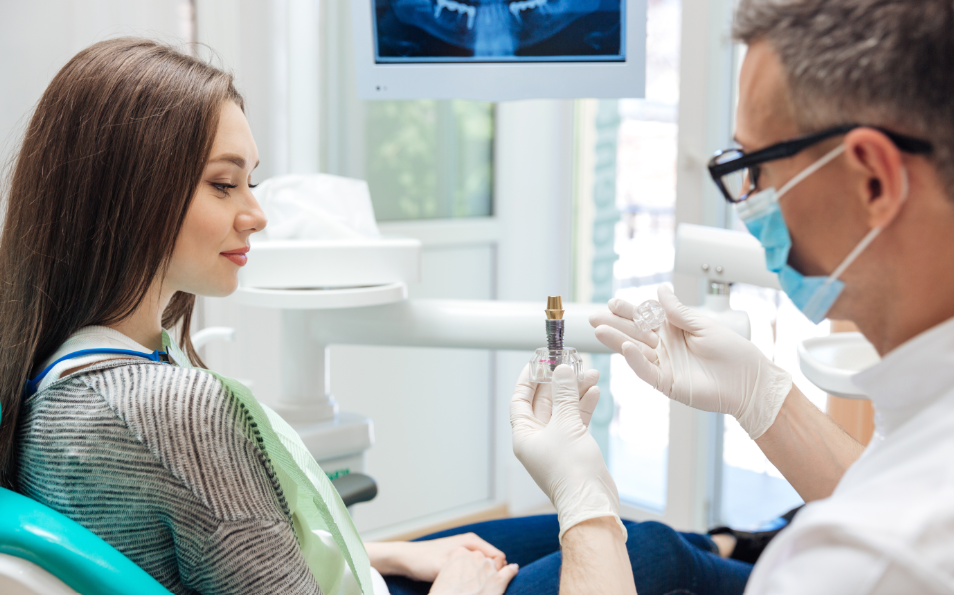
If you’re considering dental implants, you may hear your dentist use terms that sound unfamiliar. Words like “abutment,” “osseointegration,” and “implant post” can make the treatment process seem more complicated than it really is.
Fortunately, understanding a few basic dental implant terms can make it easier to follow conversations about your treatment and feel more confident asking questions. Here’s a simple guide to some of the terminology you may encounter during the dental implant process.
Dental Implant
A dental implant is a small post, usually made from titanium or another biocompatible material, that is surgically placed into the jawbone. It acts as an artificial tooth root.
Once the implant has healed and integrated with the surrounding bone, it can support a replacement tooth or other dental restoration.
Implant Post
You may hear your dentist refer to the implant itself as an implant post or fixture. This is the portion placed into the jawbone to provide a stable foundation for the rest of the restoration.
The post is not visible once treatment is complete.
Osseointegration
Osseointegration is the process through which the jawbone grows around and bonds with the dental implant. This creates a stable foundation that helps the implant function similarly to a natural tooth root.
The process can take several months, depending on your individual healing and treatment plan.
Abutment
An abutment is the connector between the dental implant and the replacement tooth. After the implant has integrated with the jawbone, the abutment is attached to the implant post.
The restoration is then secured to the abutment.
Crown
A dental crown is the visible replacement tooth attached to a dental implant. It is custom-designed to fit comfortably and blend with your natural teeth.
When an implant replaces one missing tooth, the crown is often the final visible portion of the restoration.
Implant-Supported Bridge
If several neighboring teeth are missing, an implant-supported bridge may be used to replace them. Instead of relying on natural teeth for support, the bridge is anchored to dental implants.
This can provide a stable alternative to a traditional bridge in appropriate situations.
Implant-Supported Denture
Implants can also be used to stabilize a removable denture. Unlike traditional dentures that rest primarily on the gums, implant-supported dentures attach to dental implants for additional stability.
This can help reduce slipping and make eating and speaking more comfortable for many patients.
Bone Grafting
Some patients may need a bone graft before receiving dental implants. A bone graft adds material to an area where the jawbone lacks the necessary volume or density to support an implant.
Your dentist or specialist can determine whether bone grafting is needed during your evaluation.
All-on-4 Dental Implants
All-on-4 is a treatment approach that uses four strategically placed implants to support a full-arch restoration in appropriate candidates. This option may be considered for patients who are missing most or all of the teeth in one arch.
Treatment options depend on your individual oral health, bone structure, and needs.
Mini Dental Implants
Mini dental implants are narrower than conventional implants. In certain cases, they may be used to support specific restorations or help stabilize dentures.
Not every patient or situation is appropriate for mini implants, so your dentist will recommend the option that best fits your needs.
Ask Questions About Your Treatment
You don’t need to memorize every dental implant term before your consultation. If you hear something you don’t understand, ask your dental team to explain it. Knowing what each part of your treatment involves can help you feel more comfortable and prepared throughout the process.
With the right information and a personalized treatment plan, dental implants can provide a stable, natural-looking solution for replacing missing teeth.
About the Practice
Lancaster Family Smiles provides comprehensive dental care for patients and families, including restorative treatments designed to replace missing teeth and support long-term oral health. Dr. Sam Je and Dr. Julie Jeong take a personalized approach to treatment planning and works with patients to find solutions that fit their individual needs.
Call us at (469) 729-7707 or schedule your appointment online.